
How to Choose the Right Listing Agent in Flagstaff: 3 Questions That Reveal Everything
At some point, most Flagstaff homeowners who consider selling have the same quiet moment.
It might happen when you are standing at the kitchen sink looking out at the pines. Or when you notice the worn spot in the floor where everyone takes their shoes off. Or when you start mentally calculating what your next chapter might cost, and what this one might be worth.
And suddenly, it hits you. This is not just a financial decision. It is a personal one.

Selling a home in Flagstaff can feel like selling a piece of your identity. Even when selling is the right choice, it can bring stress, doubt, grief, decision overload, and unexpected exhaustion.
Research confirms what many sellers already know. One national survey found that 62% of sellers said selling their home impacted their mental health, and 63% considered taking their home off the market because the process became too stressful.
Another survey found that 88% of homeowners admit to fears about selling. It also found that 33% feel a sense of loss even when selling is the right decision, and 45% of homeowners feel sad about selling.
This article is here to help you make a calmer decision before you even choose an agent. Not by telling you what to do, but by giving you a framework. These three questions reveal whether a listing agent can truly support you through the real experience of selling, not just the paperwork.
Why Support Matters More Than Most Sellers Expect
Most sellers think they are choosing an agent based on pricing skill, marketing reach, and negotiation strategy.
Those things matter.
But what many homeowners do not realize is that selling a home is also a psychological process. Stress changes the way people think. When sellers feel overwhelmed, they may accept the wrong offer just to be done, panic over inspection results, or pull their home off the market out of exhaustion.
These are not bad choices made by bad people. They are normal reactions to pressure.
That is why the best listing agent is not just someone who can sell your home. It is someone who can keep the process steady when things get tense.
The Core Framework: The Working Alliance (A Better Way to Choose an Agent)
There is a model used in psychology called the Working Alliance, originally developed by Edward Bordin. It describes what makes a professional relationship effective, not based on charm or personality, but based on three components.
- Agreement on Goals
Do you and your agent want the same outcome? - Clarity of Tasks
Do you understand the plan, timeline, and responsibilities? - Strength of Bond
Do you feel safe, respected, and supported in the relationship?
This framework matters because selling a home involves uncertainty, high financial stakes, and a long series of decisions. A strong alliance reduces confusion and prevents emotional decision-making.
In real estate, this is often the hidden difference between:
- a seller who stays grounded, confident, and clear
- a seller who spirals into panic, regret, anger, exhaustion, or emotional shutdown halfway through
The questions below are designed to test the alliance before you sign anything.
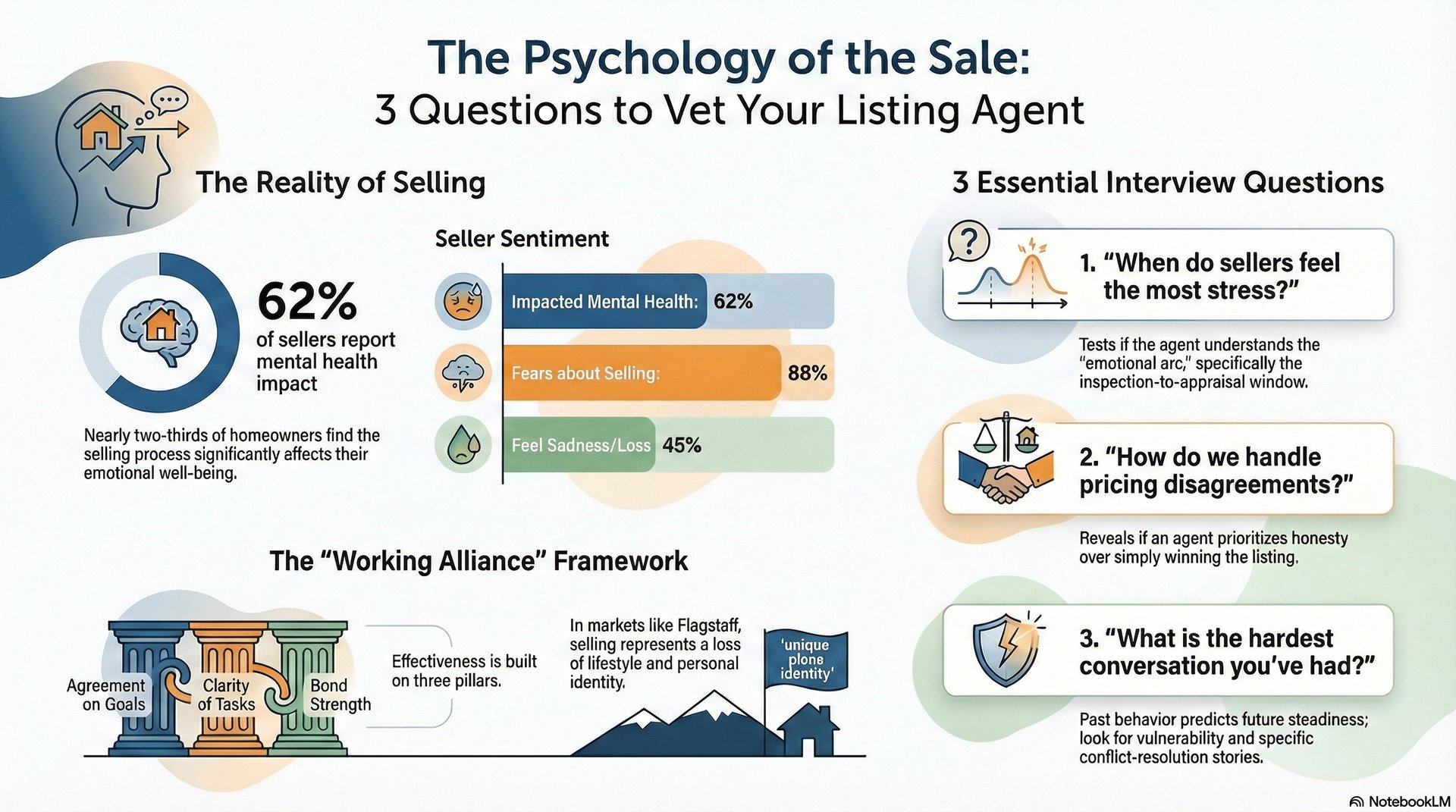
3 Questions to Ask Before You Hire a Listing Agent
These questions are not meant to be aggressive or confrontational. They are meant to help you choose someone who can guide you through the real moments of selling, especially the stressful ones.
The goal is simple. Ask questions that pull the agent out of sales mode and into real-world problem-solving mode.
Question #1: “When during the process do sellers typically feel the most stress, and what do you do about it?”
This question reveals whether an agent understands the emotional arc of a transaction, not just the transactional milestones.
A strong listing agent knows that stress does not usually peak at the listing appointment. It often peaks later, especially during the inspection-to-appraisal window. By that stage, sellers have already mentally moved on, and then repair requests or appraisal issues pull them back in. That is when the deal can feel fragile and unpredictable.
What to listen for:
- A specific phase of the transaction (not just “the whole thing”)
- A clear plan to prepare you ahead of time
- Specific actions, not just reassurance
A strong answer sounds like:
“Most sellers hit a wall between inspection response and closing. They have already emotionally moved on, and then repair requests or appraisal issues pull them back in. I get ahead of that by walking you through what is likely to happen before we go under contract, so nothing feels like a surprise.”
Red flag answers sound like:
- “I just communicate a lot.”
- “It is just business.”
- “You cannot get emotional about it.”
If the agent seems stuck, you can frame it like this:
“Do sellers usually feel the most stress during showings, inspections, appraisal, or when the home sits longer than expected?”
Question #2: “If we see the market differently on price, how do you usually handle that?”
This is one of the most important questions you can ask because pricing disagreements are the number one source of agent-seller conflict.
You are testing whether the agent will be honest with you even when it is uncomfortable, or whether they will list at your number just to win the listing and then slowly grind you down with price reductions later.
What to listen for:
- Clear data and reasoning
- A partnership tone instead of a power dynamic
- A timeline and structure if you decide to test a higher price
A strong answer sounds like:
“I will show you exactly what the data says and give you my honest recommendation. If you still want to try a higher price, I will support that, but we will set a timeline in advance. For example, two weeks. Then we agree ahead of time what happens if we do not get traction.”
Red flag answers sound like:
- “We can list at whatever price you want.”
- “Trust me, I know what I am doing.”
- “That never happens with my clients.”
If the agent seems stuck, you can frame it like this:
“How do you stay honest with the data while still respecting the seller’s comfort level and goals?”
Question #3: “Can you share a time when a sale got tense or stressful, and how you helped the seller through it?”
Past behavior is one of the best predictors of future behavior. This question reveals the agent’s conflict style, empathy, and whether they have enough experience to stay steady when things get hard.
Almost every transaction has a moment where something goes sideways. It might happen during inspections, repair negotiations, appraisal issues, financing delays, or a buyer getting cold feet. A good agent does not pretend those moments never happen. They know how to lead through them.
What to listen for:
- A real story with real details
- A calm explanation of what they did
- A clear outcome, even if the outcome was not perfect
A strong answer sounds like:
“I had a seller who was overwhelmed after the inspection report. They wanted to cancel the sale immediately. I helped them slow down, get a second opinion, and separate what was serious from what was normal. We negotiated a fair solution and the deal still closed.”
Red flag answers sound like:
- “I cannot think of anything.”
- “My sellers always listen to me.”
- “Sellers just do not understand the market.”
If the agent seems stuck, you can frame it like this:
“Maybe during inspections, repair requests, or when an appraisal came back low. Has anything like that happened, and how did you guide the seller through it?”
Why This Matters So Much in Flagstaff
Flagstaff is not a simple market. It is a lifestyle market.
Many sellers are not just leaving a home. They are leaving pine trees, mountain air, snow seasons, quiet neighborhoods, dark skies, and a way of living that feels hard to replace.
Psychologists call this place identity. It is the idea that where we live becomes part of how we see ourselves. When we leave, we do not just leave a property. We leave a version of our life.
That is why selling here can feel heavy, even when it is the right decision.
Expert Perspective: Even National Real Estate Research Now Acknowledges Emotional Support
One of the most important shifts in modern real estate education is that emotional steadiness is no longer treated as an extra skill. It is now recognized as part of what a strong agent provides.
In November 2025, National Association of REALTORS® Deputy Chief Economist Jessica Lautz wrote:
“Real estate agents remain indispensable in today’s complex housing market. Agents provide critical expertise, negotiation skills and emotional support during an increasingly challenging process.”
That is institutional acknowledgement that real estate has become psychologically demanding, and that a skilled agent helps sellers stay stable inside the process.
So when you evaluate an agent based on steadiness, responsiveness, and trust-building, you are not being soft.
You are being strategic.
Why This Matters in Flagstaff (Short Summary)
In Flagstaff, selling a home is rarely just a transaction. It is often a lifestyle transition, an identity shift, and a high-stakes financial decision all at once. With higher price points and seasonal market rhythms, the process can quietly wear sellers down over time.
Choosing the right agent is not only about who can sell your home. It is about who can help you stay clear, confident, and grounded while you do it, so you do not make reactive decisions that cost you money, peace, or long-term satisfaction.
A supportive agent helps protect both your sale outcome and your future self.